Nowadays, when discussing new modern architecture, many developers will mention Event-Driven Architecture (EDA) and Microservice Architecture. Cause these popular approaches focus on building scalable, flexible, and resilient applications. While both architectures aim to break down monolithic structures into smaller, more manageable components, they differ in how these components communicate and interact.
Event-Driven Architecture (EDA) utilizes asynchronous events to decouple services, allowing for real-time responsiveness and easier scaling. In contrast, Microservice Architecture usually involves direct, synchronous communication between services. Understanding these differences is essential for selecting the right architecture to meet your application’s specific needs.
Event-Driven Architecture (EDA)
Event-Driven Architecture (EDA) is a software design paradigm where system components interact with each other through events. An event can be any action or change in the system, such as a user request, a database update, or another component completing a task.

Key Characteristics:
- Event: An indication of a change in the system, such as “order created” or “user logged in.”
- Event Producer: A component that generates events whenever there’s a change in state.
- Event Consumer: A component that listens to and processes events, typically responding by performing an appropriate action (e.g., updating a database, sending a notification).
- Event Broker: An intermediary layer that routes events to the appropriate consumers. Common tools for event brokers are Kafka, RabbitMQ, and Amazon SNS/SQS.
- Adapter (Optional): Middleware component that converts data formats (such as JSON, XML, CSV, or custom formats) or protocols (e.g., HTTP, AMQP, WebSockets) to enable communication between incompatible systems. Some tools: Apache Camel, MuleSoft, AWS Lambda or Azure Function
Advantages:
- Scalability: Independent components can be easily added without impacting the entire system.
- Reactivity: The system can respond immediately to changes, enabling real-time processing.
Example:
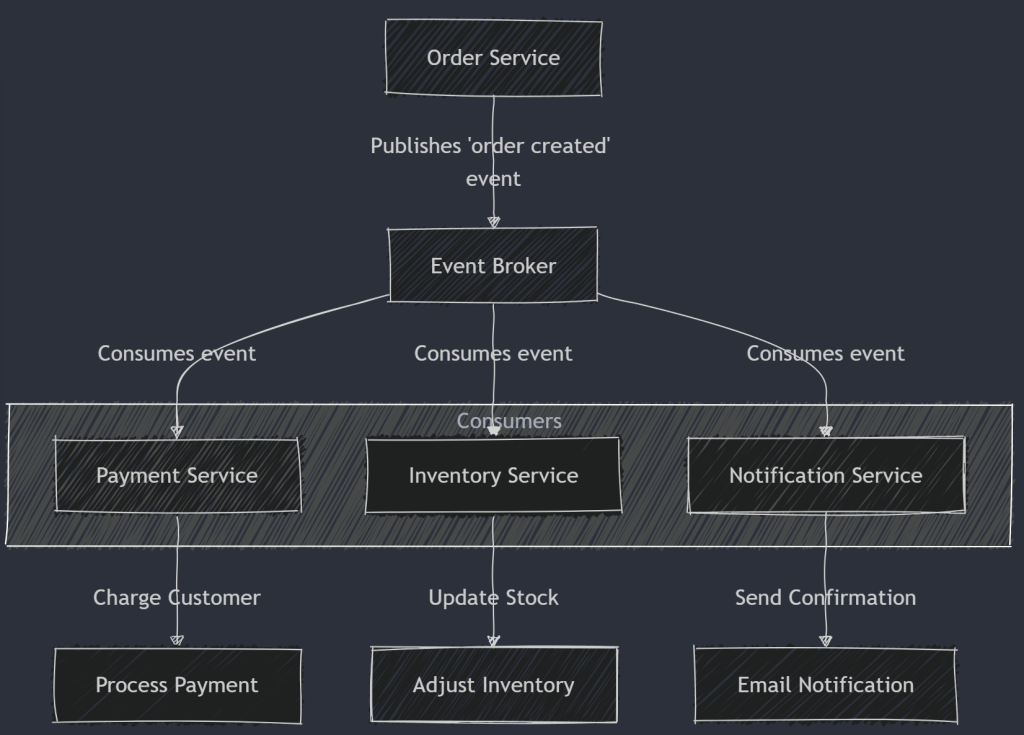
In an e-commerce system, when a new order is created, the system can publish an “order created” event. Various services (like payment processing, inventory management, and notification) can consume this event and respond accordingly, such as charging the customer, updating stock, and sending confirmation emails.
Microservices
Microservices is an architectural style that structures an application as a collection of small, independent services, each responsible for a specific business capability. Each microservice can be developed, deployed, and scaled independently.

Key Characteristics:
- Independence: Each microservice is a standalone unit and can use different programming languages or databases.
- API Communication: Microservices typically communicate via APIs (such as HTTP/REST or gRPC). Sometimes, they may also use event-driven communication.
- Statelessness: Microservices are often stateless; if state is needed, they will use an external data store (e.g., Redis).
- Fault Isolation: Each service operates independently, so if one fails, it doesn’t necessarily impact the rest of the system.
Example:
For an e-commerce application, you might have several microservices:
- Order Service: Manages order creation and status updates.
- Payment Service: Manages payment processing and verification.
- User Service: Manages user accounts and authentication.
Each of these services can operate independently, be deployed separately, and scaled based on their individual loads. For example, if the Payment Service experiences high load, you can scale only this service without affecting the others.
Combining EDA and Microservices
EDA and Microservices are often used together to build scalable, flexible systems. Microservices can communicate through events rather than direct API calls, reducing dependencies and enhancing scalability.
For example, in a microservices-based e-commerce system, when the Order Service publishes an “order created” event, the Payment Service can process the payment, the Inventory Service can update stock, and the Notification Service can send confirmation emails—all without needing direct connections between services.
Common Tools:
- Apache Kafka: A powerful distributed event streaming platform, ideal for EDA in large systems.
- RabbitMQ: A message broker used to send events between components.
Summary:
- Event-Driven Architecture allows for responsive, scalable systems by decoupling components through events.
- Microservices provide flexibility and ease of scaling by organizing applications into small, independent services.
- Combining both architectures enhances a system’s scalability, flexibility, and fault tolerance.




 VuiLenDi
Leave a comment