
When it comes to building software, choosing the right architecture can feel a bit like picking the perfect pizza – there are a lot of options, and each has its own flavor! From the classic monolithic approach to the more modern slices like microservices and serverless, every architecture has its own strengths (and quirks). So, how do you know which one will hit the spot for your project? In this article, we’ll take a light-hearted yet professional dive into three of today’s most popular architectural styles: Monolithic, Microservices, and Serverless, and help you decide which one will deliver the best results. Ready to slice through the complexity? Let’s get started!
Monolithic Architecture: All-In-One
Monolithic applications are all-in-one apps. Although they are old-fashioned, but still useful.
Comparing with Microservices and Serverless, a Monolithic application typically has all the features in a single codebase written in a single programming language and technology stack.
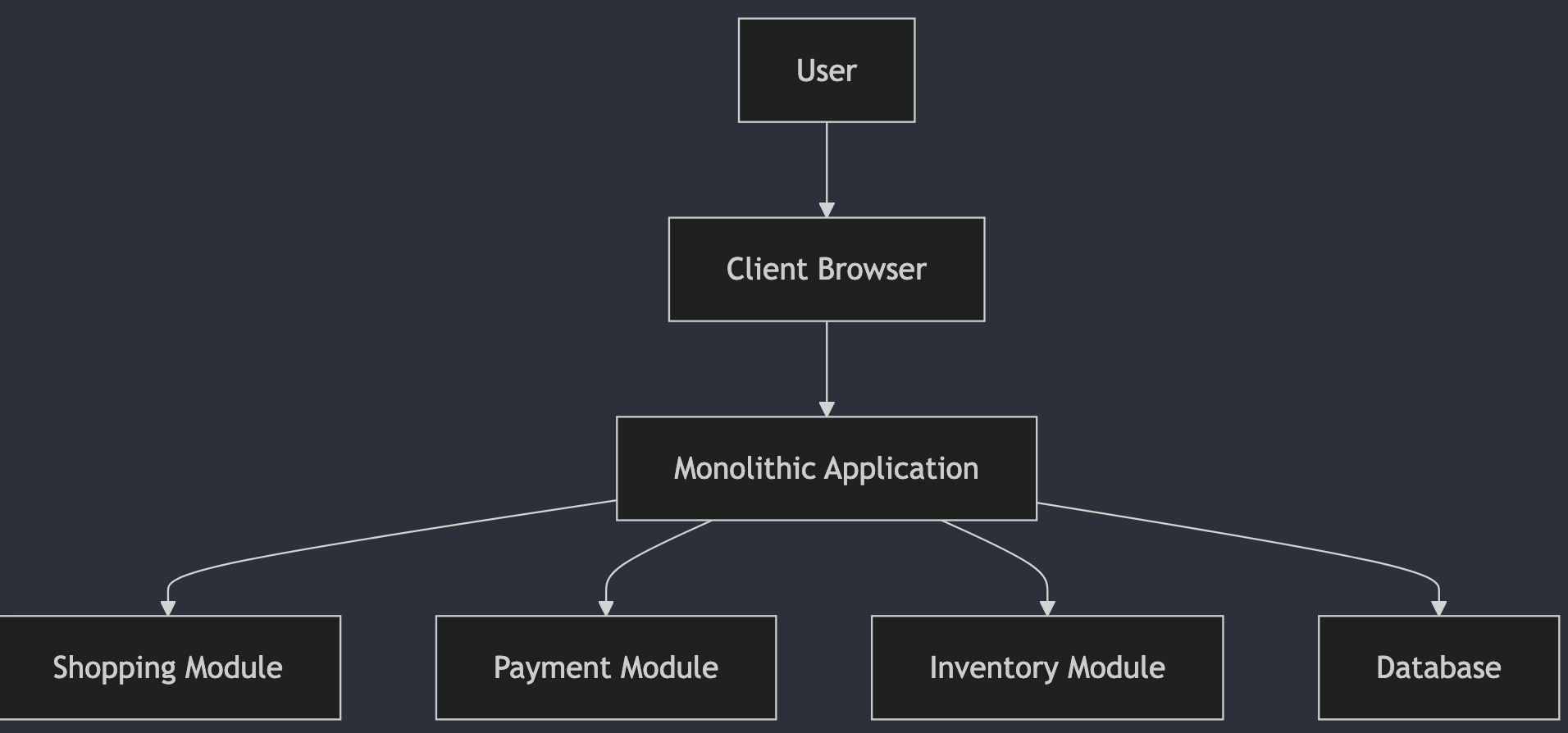
Microservices and Serverless separate the front-end and back-end also functionalities. Still, Monolithic applications built with a single entity with all functionalities, both front and back, are not very popular, but it is still an excellent way. In addition, monolithic apps have many advantages for specific situations.
- If you need your application fast, have good availability, and freely serve static content to whoever wants to consume it. (Such as WordPress for Blog)
- Apps based on monolithic architecture are typically faster, easier, and cheaper to build as they don’t involve synchronizing and connecting multiple moving parts.
Monoliths are ok for some applications, but for more complex systems, you may want to go ahead and break it down into microservices.
Advantages of Monolithic Architecture
Transaction Control and Data Integrity
Monolithic apps often use a single relational database, simplifying transaction management and ensuring data integrity.
Faster, Easier, and Cheaper
Monolithic architectures are straightforward to build, reducing development time and costs. They’re ideal when simplicity meets project requirements.
Simplified Testing and Deployment
With everything in one place, testing and deploying updates are easier. You can test the entire app on a local machine or staging environment with minimal setup.
Simple Infrastructure
Using a single server for the front end, back end, and database simplifies infrastructure. A CDN like Cloudflare can further enhance performance and security.
Easier Monitoring
A unified architecture allows for simpler monitoring since all components run on the same system.
Disadvantages of Monolithic Architecture
Large Codebase
As the app grows, the codebase can become complex and difficult to manage, making it harder to onboard new developers.
Challenging Updates
Any update requires redeploying the entire application, increasing the risk of introducing new bugs.
High Dependency Coupling
Components are tightly coupled, so changing one can affect others. This makes testing more complex and time-consuming.
Limited Flexibility
You’re restricted to one tech stack for the entire application, limiting your ability to use specialized tools for specific functions.
Scalability Issues
Monolithic apps can struggle to scale efficiently as demands grow, often requiring a shift to microservices or serverless architectures for future scalability.
Microservice Architecture: A Scalable and Modular Approach to Modern Systems
Microservices are smaller pieces of a more extensive app. They offer more flexibility and performance but at a higher cost and complexity.
When choosing the right architecture for your project—whether it’s Monolithic, Microservices, or Serverless—it’s important to understand their distinctions. Microservices represent an architectural pattern that structures an application as a collection of loosely-coupled, fine-grained services communicating through lightweight protocols. Unlike Monolithic architecture, where the entire application is built as a single codebase, Microservices allow each service (such as payment, shipping, etc.) to be developed, deployed, and scaled independently, using the best-suited technologies for each function.

Microservices architecture is not a new concept. The microkernel approach from the 80s and 90s, along with service-oriented architecture (SOA) in the 2000s, similarly broke applications into components. However, with the rise of cloud-based environments, Microservices has truly come into its own. The ability to run applications in a distributed manner across multiple servers, combined with cloud infrastructure’s scalability and flexibility, has driven the rapid growth and adoption of Microservices in modern software development.
As systems have grown more complex, decoupling services has become crucial for managing risk—ensuring that the failure of one microservice doesn’t bring down the entire application.
Advantages of Microservices Architecture
Iterative Development
Microservices align well with agile methodologies, allowing for iterative development. By breaking the application into independent services, new features can be developed and deployed faster, while different teams can work in parallel, improving collaboration and onboarding.
Flexibility
Unlike Monolithic architectures, where everything is tightly coupled, Microservices enable teams to work on individual services independently, allowing for greater flexibility in development and deployment.
Tech Stack Freedom
One of the standout advantages of Microservices is the freedom to choose different tech stacks for different services. Each service can be built with the technology that best fits its requirements, offering flexibility that monolithic architectures lack.
High Availability
Microservices’ loosely coupled nature ensures that if one service fails, it doesn’t impact the entire application. This leads to higher availability, as the rest of the system remains operational, unlike in Monolithic applications where a single failure can bring down the whole system.
Scalability
Microservices allow for easier scaling by enabling independent scaling of each service. While the upfront cost of implementing a Microservices architecture is higher, it’s often more cost-effective to scale than a monolithic system, due to the modular structure.
Improved Performance
By distributing services and loads across multiple servers, Microservices can significantly enhance performance compared to monolithic systems that rely on a single server.
Disadvantages of Microservices Architecture
Increased Complexity
While Microservices offer flexibility, they add complexity in managing multiple independent services that need to work together. Each service may require its own infrastructure, increasing the overall system complexity.
Complex Testing
Although smaller codebases are easier to test, ensuring that all services communicate correctly introduces testing challenges, especially as the application scales.
Higher Upfront Costs
Microservices demand higher initial investment due to the need for separate teams, dedicated tools, and more complex deployment pipelines. Setting up the infrastructure and maintaining multiple services adds to the upfront cost.
DevOps Expertise
Microservices often require specialized orchestration tools like Kubernetes, as well as experienced DevOps engineers to manage deployments. This can be costly and finding skilled DevOps talent can be a challenge due to high demand.
Serverless Architecture: Simplified Scaling and Infrastructure Management
Cloud-native development. You don’t manage the server that runs your application.
Serverless architecture lets you create and run applications and services without managing infrastructure. Instead, your cloud provider(AWS, GCP, AZURE, etc.) handles all server administration, even though your application runs on servers.

Serverless is closely related to microservices. Many modern applications combine serverless and microservices. Like microservices, the concepts that underpin serverless have been around for a long time but have become a fixture in mainstream software development since the rise of cloud computing.
Serverless architecture has been around for more than a decade,
Amazon introduced the first mainstream FaaS platform, AWS Lambda, in 2014. Currently, most developers still use AWS Lambda to build serverless applications. Still, Google and Microsoft have their own FaaS offerings, called Google Cloud Functions (GCF) and Azure Functions.
Serverless vs. Microservices
In one sentence, the difference between microservices and serverless is that the former is a way to design an application, and the latter is a way to run all or part of an application. That’s the key to their compatibility. It’s possible to code and run a microservice as a serverless function.
- The serverless architecture consists of a set of functions rather than services.
- A service runs continuously, but a function has a lifecycle – it starts, runs, does its job, and then stops.
- Serverless functions only run on demand, which can save a lot of resources.
- In serverless architecture, the serverless platform provider takes care of infrastructure provisioning.
- The development team doesn’t have to configure the entire software system.
- Functions are uploaded to the serverless platform, the triggers that will launch them are configured, and the provider takes care of the rest.
- Microservices would usually be used for parts of an application that need to run constantly, like the front end of a user application.
- Serverless works best for functions used occasionally and for a limited time.
- Serverless functions hosted on a serverless platform can also be used across multiple applications.
Serverless architecture is less flexible than microservices. Serverless providers only natively support specific programming languages, frameworks, and tools; while there are workarounds, they can be complicated and problematic. And every serverless platform supports different technologies, meaning running the same function with different providers is impossible without reconfiguring it to some extent.
Serverless tooling is also generally considered less mature than it is for microservices. For example, serverless monitoring and log configuration tools are limited.
While entire applications are built of serverless functions in a pure serverless architecture, in most cases, it makes the most sense to run certain services as serverless – those that are not in permanent use and have a relatively short run-time, especially if that run-time is resource intense.
The future of serverless architecture is probably a technology that complements, rather than replaces, microservices.
Advantages of Serverless Architecture
1. Flexibility
Breaking applications down into serverless functions offers similar flexibility advantages as microservices.
2. Cloud computing costs
Calling and killing functions, so they only run for as long as required, can potentially lead to significant savings in cloud computing overheads compared to them being permanently available.
3. No need to provision infrastructure
The serverless provider providing the cloud infrastructure serverless functions run on means the software development team has one less thing to worry about and can focus on coding the application itself.
4. Scalability
As with microservices, the modular nature of serverless makes it easier for software development teams to scale applications as new functions can be worked on independently and added incrementally to the live app.
5. Reliability and availability
Again, as with microservices, an app being split into loosely coupled functions means there is a far lower level of dependence across functions than would be the case in a monolithic architecture. So if one function fails, the app should keep working otherwise. The provider taking care of underlying infrastructure also further reduces potential points of failure.
Disadvantages of Serverless Architecture
1. Complexity
Being broken down into independent functions means it still consists of multiple, smaller moving parts, making it more complex than a monolithic approach.
2. Tech stack limitations
Serverless platforms only support specific languages, frameworks, and tools, which means you are limited to coding functions using those supported by your provider.
3. Vendor lock-in
Applications that are entirely serverless or include serverless functions are relatively tightly tied to the provider platform they were built for because no two are the same and interchangeable. Of course, it’s far from impossible to reconfigure serverless functions for a different provider’s platform. However, doing so for an extensive, complex application involving numerous functions would be a significant undertaking.
4. Immature tooling
Compared to traditional monolithic and microservices, it is often argued that the tooling available to support serverless development and maintenance is immature. For example, a lack of good monitoring and log configuration support is regularly highlighted. However, with serverless architecture quickly gaining traction, tooling will inevitably mature.
Conclusion
Monolithic architecture is ideal for small applications due to its rapid development, ease of testing and debugging, and low cost. However, as the system grows, it may impede business and should evolve into a different form.
Using microservices has many advantages. You can build applications that are easier to change and manage without causing errors. You can also work with your team more smoothly on a project, no matter how much experience you have—from beginners to experts.
Serverless describes how the program works inside, while Microservices describes how to design your application outside. A serverless application can follow or ignore the ideas of microservices (but this is often the recommended way to do it). Any, some, or none of the microservices in a microservices design can use serverless technology.
Serverless is a great way for businesses to make scalable, light apps faster. But Microservices can work better if your apps have many long-running, ongoing tasks. In a mixed design, developers can use Microservices for most requests but give some fast jobs, like database storage, to serverless actions.
Reference:





 VuiLenDi
Leave a comment